 Seabook
Scuba dive log: what to record and how.
The fields every entry needs, a worked example, and what your log can tell you about your air.
Get the appWhy divers keep a log.
A scuba diving log does three jobs. It is proof of experience: some courses ask for a number of logged dives, and many dive centres look at your count and your last dive date before taking you to a deep or current-swept site. Requirements vary, so check with the provider.
It is your own reference. How much lead did you carry with a 5 mm suit and an aluminium tank? How long did 200 bar last at 18 metres? The answers are in your last entries, not in your memory.
And it is a diary. The dive where the manta came back three times deserves more than a number.
The fields of a dive log entry.
The first six make a useful basic record. The rest are what you will look up later.
- Dive number and date
- Number dives in order. The date also tells a dive centre how recently you were in the water.
- Location and dive site
- Country or region, then the site name as the local operator calls it.
- Maximum depth
- The deepest point of the dive, from your computer or depth gauge.
- Dive time
- Time in and total duration, surface to surface, as your computer records it.
- Start and end pressure
- Tank pressure when you jumped in and when you surfaced. This is the raw data for your air consumption.
- Tank size and gas
- Volume and material of the tank, and the mix if it was not air.
- Weight
- How much lead you carried and whether it felt right. Future you will ask.
- Exposure suit
- Thickness and type. Weight only makes sense next to the suit you wore.
- Water temperature and visibility
- Conditions explain a lot about gas use and comfort.
- Type of dive
- Boat or shore, reef, wall, wreck, drift, night. In Seabook these are tags on the dive.
- Buddy or guide
- Who you dived with, and the centre that took you out.
- Marine life and notes
- What you saw and anything you want to remember or do differently.
A filled-in dive log entry.
One real entry, as it looks in the Seabook dive log.
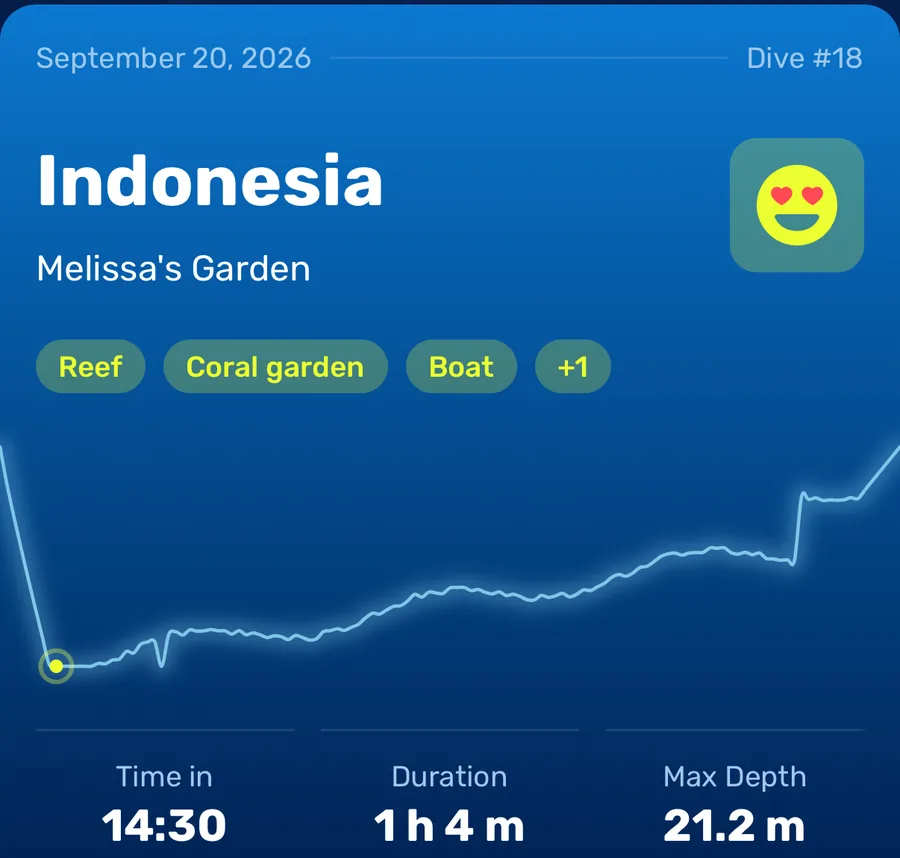

- Dive
- #18
- Date
- 20 September 2026
- Location
- Indonesia
- Site
- Melissa's Garden
- Type
- Reef, coral garden, boat
- Time in
- 14:30
- Duration
- 1 h 4 min
- Max depth
- 21.2 m
- Gas in
- 200 bar
- Gas out
- 80 bar
- Tank
- 12 L
- Weight
- 4 kg
- Sightings
- 5 species
- Notes
- Endless hard coral. Our guide found a pygmy seahorse on the first sea fan.
How to log a dive.
- Read your pressure before you take the kit off.End pressure is the one number nobody remembers ten minutes later.
- Take depth and time from the computer.Scroll its logbook for maximum depth and dive time, or sync it and skip this step.
- Write the site name while the guide is still nearby.Ask how it is spelled. Local names are hard to recover later.
- Note weight and how it felt."4 kg, slightly heavy at the safety stop" is worth more than "4 kg".
- Add what you saw.Name the animals while you can still picture them. If you are unsure, a photo and an identification later will do.
Work out your air consumption from the log.
Your surface air consumption rate, or SAC, helps you estimate how much gas you use at different depths. Everything you need is already in a dive log entry, plus your average depth, which a dive computer records.
Take the entry above and say the average depth was 12 metres.
Gas used: 200 bar - 80 bar = 120 bar. In a 12 litre tank that is 120 x 12 = 1,440 litres.
Per minute: 1,440 / 64 minutes = 22.5 litres per minute at depth.
Pressure at 12 metres is 2.2 bar, so at the surface that is 22.5 / 2.2:
SAC of about 10 litres per minute.
Log it for a few dives and you will see it drop as you relax, and rise in current or cold water. That trend is one of the most useful things a log can show you. It is an estimate, not a gas plan: always keep a reserve and plan the dive the way you were trained.
Paper or digital?
Paper is still the simplest way to collect stamps and signatures, and some courses expect them. A digital dive log wins on everything else: it cannot get soaked, it is searchable, and a dive computer can fill most of it in for you. Many divers keep both. See the comparison.
How the Seabook dive log app worksImport from a dive computer
Dive logging questions.
Do I have to log my dives?
No law requires it, but training agencies ask for logged dives before advanced courses, and dive centres often check your count and your last dive date before taking you to deeper or harder sites. A log is also the only reliable record of the weight and gas that worked for you.
How do I count my dives?
Number them in order from your first open water dive. Most divers count any dive with a real descent, not pool sessions. If you lost track, estimate honestly, note the estimate in your log, and count precisely from there.
When should I fill in my dive log?
Right after the dive, while the tank pressure, the weight and the name of that nudibranch are still in your head. A dive computer keeps depth and time for you, but not the rest.
What is bottom time in a dive log?
Traditionally bottom time runs from the start of the descent to the start of the final ascent. Dive computers record total dive time, surface to surface, and that is the number most divers log today. Use one definition consistently.
How do I log a dive without a dive computer?
Note your time in and time out from a watch, read maximum depth from your depth gauge before ascending, and write down start and end pressure from the SPG. Those five numbers are enough for a useful entry.
Start your log at dive one.
Or at dive two hundred. Add past dives by hand and let the new ones import.